What's new
Photoshop Gurus Forum

Welcome to Photoshop Gurus forum. Register a free account today to become a member! It's completely free. Once signed in, you'll enjoy an ad-free experience and be able to participate on this site by adding your own topics and posts, as well as connect with other members through your own private inbox!

AI......A Tool. What do you think?


This is a big read and I haven't finished it yet, but for me the problem was addressed here:


My opinion is that unless the AI takeover is not stopped, there will be no support for a productive economy. A company is setting itself up for an eventual death by utilizing and replacing humans in the workforce. You will have no customer base to purchase whatever product or service you provide if no one can afford your wares due to unemployment. Employment means taxation, governments (and programs) will fail without a solid tax base.

I believe the AI bubble will crash and burn hard unless humanity can come up with a better system than the monetary system we have. Everyone needs to work. For those that might say there's other means of employment that AI will not affect, look at it from a statistics viewpoint, you will have way too many plumbers competing for what little work that remains from the small percentage of people who are lucky enough to be employed.

The even bigger fear is what happens to society when all of the unemployed peoples needs are not being met by diminishing subsidies. (Advocating!) People will take what they need by force. A common and ridiculous misconception of the egotistical is that you can defend what you have..................you can't.
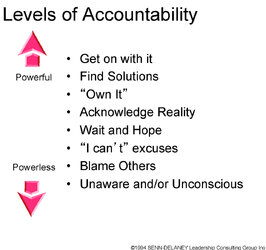
This is an accountability model I've used personally and in business for many years. One reason I've found it useful is that “Acknowledge Reality” is the point where we begin moving from powerless to powerful. That doesn't mean we like the reality, approve of it, or accept that its consequences are inevitable. It means we can't intelligently influence something until we're willing to see it as it actually is.


That's really why I posted the Gates article. Not because I'm advocating where AI may take us, but because I think understanding both its potential and its consequences is the first step toward deciding what we should do about it.


The next steps on this model are “Own It,” “Find Solutions,” and “Get on with it.” To me, that's where the useful AI discussion ultimately needs to go. What can individuals, businesses, communities and governments actually influence? What protections or policies make sense? What incentives should change? What do we want the future to look like, and what are we willing to do to help shape it?


We may disagree considerably about what AI ultimately means for society. But pretending the technology isn't advancing, or simply waiting to see what happens, doesn't give us much influence over the outcome.

.Levels-of-Accountability.jpg
 
This post about AI is more narrowly focused on the impact on image processing tools.
On another forum, the question was asked: "Do you think post-processing tools will survive the AI revolution?

I am copying my response to this forum since it seemed to fit with the topic of this forum thread:

--------------------------------
Buckle up, this post is long.
I have been both an electrical engineer and an engineering manager, during which technology changed how we did things by 30% each year. Staying competitive meant in the presence of disruptive technologies is not new. I wrote my inputs from that perspective, which is associated with a concept and book named "The Innovator's Dilemma."

A Different Perspective: AI, Post-Processing, and the Innovator's Dilemma

I've been following this discussion and would like to suggest looking at the question from a somewhat different perspective.

Rather than starting with whether Photoshop, Lightroom, or other post-processing software will survive AI, perhaps we should start with the marketplace for images itself.

There is, and will continue to be, a broad marketplace for images, both digital and printed. But that marketplace consists of many different segments, each with different needs and expectations.

Consider commercial advertising, product photography, portraits, real estate, journalism, fine art, family photographs, restoration, and photography pursued purely for personal enjoyment. These are all markets for images, but what customers or participants value can be quite different.

Some place the greatest value on authenticity. Others prioritize artistic expression, precise control, speed, cost, convenience, or simply obtaining an image that meets a particular need.

The important distinction is between WHAT the market wants and HOW those wants are satisfied.

The "what" may remain relatively stable, while the "how" has changed repeatedly.

We've gone from film and darkrooms to digital cameras and sophisticated post-processing software. Now we are seeing AI-assisted editing, AI-generated imagery, and increasingly automated workflows.

The methods change, but the underlying needs and the different market segments do not necessarily disappear.

This brings me to a concept from business and technology called disruptive innovation.

Clayton Christensen explored this extensively in his excellent book, The Innovator's Dilemma: When New Technologies Cause Great Firms to Fail.

One of his central observations was that disruptive technologies often begin by serving markets that established companies consider less demanding, less profitable, or simply not worth pursuing.

Initially, these technologies may be inferior to established solutions on many traditional measures. But they can offer something different that certain customers value, such as lower cost, greater convenience, or much easier access.

As the technology improves, it becomes good enough to satisfy additional market segments, including some that previously required more sophisticated and expensive solutions.

The disruption happens not necessarily because the new technology is better at everything, but because it becomes good enough for an increasing number of customers.

This seems particularly relevant to AI and image processing.

Today, a skilled Photoshop or Lightroom user may produce results that are substantially better than those from a fully automated AI solution. For certain market segments, that difference is critically important.

But for other segments, the AI result may already be good enough, especially if it costs less or requires a fraction of the time.

As AI improves, the number of segments for which it is good enough may expand. That doesn't mean every segment will eventually use AI, or that traditional skills will become worthless. It does suggest that the economic opportunities associated with different methods of producing images could change significantly.

And that leads to another important point from Christensen's work.

Established companies can fail even when they are well managed, technologically capable, and responsive to their best customers.

Sometimes their success in serving existing customers makes it difficult to recognize or invest in emerging markets that initially appear less attractive. By the time the new technology becomes competitive in their core markets, adapting may be considerably more difficult.

Adobe and other post-processing software companies may face some version of this challenge. Their success will depend not simply on adding AI features, but on recognizing how the markets they serve are changing.

I think the same perspective is worth considering for those of us who have developed substantial post-processing skills.

Rather than asking only whether AI can match what we do today, perhaps we should also ask:

  • Which image market segments will continue to value the skills and control we provide?
  • Which segments might increasingly accept a less expensive, faster, AI-based alternative?
  • As AI improves, which of those boundaries could move?
  • And how might our existing knowledge, experience, and artistic judgment be applied using these new methods rather than competing against them?
There will undoubtedly remain people for whom the process of photography and post-processing is itself the reward. That is a legitimate and potentially enduring market segment.

But the economics of commercial image production are driven substantially by what customers are willing to pay for, not necessarily by how much skill or effort went into producing the result.

For anyone interested, here are two useful introductions to Christensen's thinking:

The Innovator's Dilemma — Christensen Institute:
The Innovator's Dilemma: When New Technologies Cause Great Firms to Fail - Christensen Institute

What Is Disruptive Innovation? — Harvard Business Review:
What Is Disruptive Innovation?

My point isn't that AI will eliminate post-processing software or skilled photographers. Nor is it that Adobe is destined to fail.

Rather, I think we may be focusing too much on defending or predicting the survival of today's tools, when the more interesting issue is how the different markets for images will evolve, and which methods of creating and processing images will best serve each of them over time.

That seems to me a more useful way of thinking about what AI may mean for both the software industry and those of us who use its products.

-----------------------------

The topic of AI is much broader than image processing software, and I am not trying to minimize other concerns as AI is evolving more rapidly than other Disruptive Technologies. Just thought this was a smaller bite to chew off and closer to home for photo editing/creation software.


John Wheeler
 
The important distinction is between WHAT the market wants and HOW those wants are satisfied.

The disruption happens not necessarily because the new technology is better at everything, but because it becomes good enough for an increasing number of customers.


when the more interesting issue is how the different markets for images will evolve, and which methods of creating and processing images will best serve each of them over time.

That seems to me a more useful way of thinking about what AI may mean for both the software industry and those of us who use its products.

Just thought this was a smaller bite to chew off and closer to home for photo editing/creation software.
Great observations! Well done and greatly appreciated!

You've clearly pointed out the larger problem and asked some of the right questions. Now I would like to hear, based on your personal observations, how AI, inside or outside of Photoshop, is currently affecting the smaller bite of the photo editing industry?

I would also like to hear your take on the qualification standards and skills of those who use AI to edit photos and how they are impacting the industry.................are they good enough in your opinion?

Should there be some form of regulation or professional Standards and protection, such as a formal licensure, certification, or bodies (similar to those in architecture or engineering) that could protect trained designers from undercutting and exploitation, establish clearer baseline competencies, and build greater respect for the profession?
 
I have quite the propensity to say too much or write so much and sometimes put it through AI to make it more concise. I did not do that here (so that's a heads up).

Thanks for the thoughtful questions. They are certainly relevant, but I'd like to approach them from the same market perspective I was attempting to introduce in my earlier post.

The question of how good today's AI editing tools are, or how skilled their users may be, is important. But I think concentrating on those questions can cause us to overlook the larger implications of a disruptive technology.

My central point is that the marketplace for images will continue to exist, but the ways in which the different segments of that marketplace are served will change.

Some customers will continue to demand the highest levels of craftsmanship, control, authenticity, and artistic judgment. Others will be perfectly satisfied with an image that meets their needs at a lower cost, with less effort, or in much less time.

The market ultimately determines which combination of quality, cost, speed, creativity, and other attributes is valuable enough to pay for.

That brings us back to Christensen's The Innovator's Dilemma.

One of the important lessons from disruptive innovation is that the new technology doesn't have to be as good as the established technology in every respect to begin changing a market.

It only needs to be good enough to satisfy the requirements of some market segments, often ones that established providers consider less attractive.

As the technology improves, it can begin satisfying the requirements of additional segments. The boundaries between those segments can shift, sometimes considerably.

So the important question isn't simply whether today's AI tools or their users can match a skilled Photoshop professional. It's how many customers currently require that professional's level of skill, and how that number might change as the alternatives improve.

That distinction has implications for two groups.

First, the software companies.

Companies like Adobe, DxO, Capture One, and others need to consider not just how to improve their existing products, but how the needs of the overall image marketplace are changing.

Adding AI capabilities to existing software may be part of the answer, but it may not be the entire answer. If increasing portions of the marketplace can be served by simpler, cheaper, or entirely different methods, the business models supporting today's products could change.

The question is not necessarily whether Adobe can build better software than a new competitor. It is whether the marketplace will continue to place sufficient value on what Adobe offers, and whether Adobe can successfully serve the emerging opportunities.

Second, the people who use these products, particularly those who earn their living in the image business.

I think they face a similar challenge.

Someone with considerable experience in traditional post-processing may possess valuable skills and artistic judgment. Those abilities don't suddenly disappear because AI comes along.

But the marketplace's willingness to pay for the application of particular skills can change.

For example, if AI makes a certain level of photo editing inexpensive and widely accessible, customers who previously paid professionals for that work may no longer need to. Meanwhile, other market segments may continue to place a premium on human judgment, creative direction, authenticity, consistency, or specialized expertise.

There may also be entirely new opportunities that don't exist today.

For those who enjoy photography and post-processing as a hobby, none of this necessarily requires any change. The enjoyment of the process is itself the objective. They can continue using whatever tools and techniques give them satisfaction.

But for someone whose livelihood depends on producing or processing images, I think the implications are different.

The challenge becomes understanding which parts of the marketplace will continue to value your skills, which parts are changing, and what additional capabilities might be needed to remain relevant.

That could mean learning AI tools, developing new services, moving into market segments where human expertise remains especially important, or combining established photographic skills with emerging technologies.

Regarding professional standards, certification, or licensing, I can see value in establishing competencies, especially where accuracy, authenticity, safety, or professional accountability matter.

But I would distinguish standards that protect customers from those intended primarily to protect existing practitioners from competition.

Certification may help customers identify qualified professionals. However, it does not necessarily prevent a disruptive technology from changing what customers need or are willing to pay for. Nor does it guarantee that the skills being certified will retain their present market value.

And this is really the larger point I'm trying to make.

The most important question may not be whether AI can do what skilled post-processors do today. It may be whether the marketplace will continue to need those same things done in the same way, and in the same quantities, five or ten years from now.

That is the question software companies need to consider when planning their futures.

And I think it is equally important for people who depend economically on those software products and their own expertise.

The Innovator's Dilemma is valuable precisely because it encourages us to think beyond the limitations of today's technology and examine how markets evolve as technologies improve.

I'm not predicting the demise of Adobe or professional post-processing. I'm suggesting that understanding how disruptive innovation unfolds may be more useful than trying to determine whether today's AI tools are already good enough to replace today's skilled practitioners.

Rather than debating whether AI is good enough to replace the skills we have today, shouldn't we be asking which of those skills the marketplace will continue to pay for tomorrow, and what new skills or services that marketplace may begin to value?

Well, I did give you a heads-up about post length :joy:

I might be reacting to posts I see (mostly on other forums) where there is a lot of grousing about AI and that such images are just simulations of real photos and that they don't contain the human factor that skilled folks can bring to the table. That is valid, yet it doesn't acknowledge that new tools affect the marketplace and the market value of a given set of skills over time. That is why I am encouraging a heads-up approach to what is happening as opposed to what I see on some forums, which are more akin to burying one's head in the sand.

Without repeating it here, it goes back to the prior slide I posted about Levels of accountability.

I will add another post with an analogy, yet will stop here due to length.

John Wheeler

 
Now for the analogy:

Consider an analogy that is much closer to home for this forum.

Compare Photoshop CS6 from 2012 with the latest version of Photoshop today.

Think about the skills, experience, and time required to accomplish certain editing tasks in CS6 versus what someone with considerably less experience can accomplish using today's Photoshop.

Tasks involving complex selections, removing unwanted objects, replacing backgrounds, or blending elements into an image once required considerable manual effort and expertise. Many of those tasks can now be accomplished much more quickly using automated and AI-assisted features.

CS6 was itself a very capable program, with advanced features such as Content-Aware Patch. But today's Photoshop can perform tasks that would have required considerably more time and manual intervention in CS6.

Now consider some of the same questions being raised here about AI.

Is someone using today's automated Photoshop tools as skilled as someone who mastered the manual techniques in CS6? Do they need to be? Should the person who spent years mastering those techniques be protected from competition by someone who can now accomplish a similar result with a few clicks?

And perhaps most importantly, does the customer care which version of Photoshop was used, how much effort was involved, or whether the person producing the image possesses all those older manual skills?

Some customers certainly might, particularly where specialized expertise, precise control, or authenticity is important. But many others are primarily interested in the quality, cost, and timeliness of the finished image.

The older skills haven't necessarily lost their usefulness. But the marketplace may no longer place the same economic value on some of them.

This evolution has already taken place within Photoshop over the past fourteen years. AI now introduces the possibility of similar changes occurring much more broadly, including outside the traditional post-processing applications altogether.

So rather than asking whether today's AI users have the same skills as yesterday's Photoshop experts, perhaps the more useful question is which skills the marketplace will value tomorrow.

For those of us who depend on image production for income, understanding that distinction may be far more important than debating whether the older or newer methods require more skill.
 
Thanks for the reply! You make some valid observations and raise new questions.

The one thing I think you're missing is that you speak as though there will still be a need in the near future for contracted participation in photo editing. Which skills will the marketplace value tomorrow? The reality is that there will soon be no marketplace for tomorrow and skills are irrelevant. There's really nothing to debate here. Whether or not you and I as well as software companies acquire and embrace AI tech, photos are now edited in a phone app/IOS or downloaded and edited with AI online or native OS AI's. There's no need to hire someone to edit images when literally anyone can just use AI. AI will become the only tool needed.

Let me stress, we may not be there yet, but as we all know and understand, AI is only getting better! Enjoy what time you have left, but if you're dependent on image production/editing for an income, the smartest thing you can do now is to start searching for a new field that AI can't reach and establish yourself before that market is saturated with all the rest of those displaced by AI who are looking for jobs as well!

Just so you know, I'm at peace with AI. I saw the writing on the wall long ago and have experienced the detriment of AI affecting my own personal (graphic) career. I had several YouTube accounts that have all gone AI now. There are more that I've lost to "other" designers who have undermined my pricing with ("acceptable") AI generated work. Lucky for me I'm not dependent on anything to live out my retirement. So I will be just fine. Photoshop is quickly becoming just a hobby for me now.
 

Back
Top